
An email to your boss about concerns should explain what is happening, how it affects the work, and what you would like to discuss or change. Specific observations give a manager something to act on. Accusations, vague frustration and a long history of unrelated disagreements can obscure the actual problem.
The two samples below provide starting points for raising a workplace issue professionally. Adapt them to the seriousness of the concern and the process your employer uses. Keep a routine request for support distinct from an urgent safety issue or a formal complaint that needs a designated reporting channel.
Before drafting, decide whether you want clarification, a private meeting, a workload decision, or a written record. Your email can be brief when its purpose is to arrange a conversation. It needs more supporting detail when the recipient must make a decision without meeting you first.
Separate what you observed from what you assume
Record relevant dates, tasks, instructions and outcomes in neutral language. “The deadline changed from Thursday to Tuesday after the supplier confirmation” is easier to investigate than “Nobody respects the schedule.” Where you are uncertain, say that you would like clarification rather than presenting your interpretation as an established fact. Describe your own experience and avoid speaking for colleagues who have not asked you to do so. Attach only the records needed to understand the issue, with sensitive information shared through the appropriate internal process.
Connect the concern with a practical decision
A manager can respond more effectively to a defined choice. For a workload problem, list the competing deadlines and ask which task should take priority. For an unclear responsibility, identify the overlap and ask who owns the next step. For a communication problem, describe the missed handoff and propose a workable update routine. You do not have to solve the issue yourself, but suggesting an option shows what a useful outcome could look like. Avoid promising extra work or a new deadline that you cannot reasonably meet.
Choose recipients and urgency carefully
Send a routine concern to the person who can address it. Copying a large group may expose private details or make a conversation harder. If your manager is directly involved in the concern, check the employer reporting procedure for an alternative contact. Use an urgent subject only when a timely decision is genuinely needed. For an immediate danger, use the relevant emergency or workplace safety process rather than waiting for an email reply. A written message can document the facts afterwards without replacing a time-critical report.
Follow up with a short record of the outcome
After a discussion, summarize the agreed priorities, responsible people and next review date. Keep the summary factual and invite corrections if your understanding is wrong. If you receive no response, follow up within a period appropriate to the work deadline and the normal availability of the recipient. A reminder should point back to the original request instead of adding a new set of grievances. Keep an organized copy of relevant correspondence under your employer policies, especially where customer, personnel or commercially sensitive information is involved.
Worked example for adapting the wording
An employee has a client presentation due on Wednesday and a reporting task due on the same day. Rather than writing “I have far too much work,” the employee identifies the two deliverables, their estimated remaining effort, and the consequence of missing either deadline. The request becomes: “Could we agree which item takes priority, or whether the reporting deadline can move to Friday?” This gives the manager a decision to make. If a priority is agreed verbally, a brief follow-up can confirm it. The example is about clarifying workload, not refusing an instruction or asserting that every busy period requires a formal complaint.
2 templates, samples and download previews
The previews below show the available examples. Download buttons identify the offered file format; many files are supplied in ZIP packages that must be extracted first. Word and PDF versions of the same example count as one template, not two different designs. Choose an example for its purpose, then check the actual extracted file before editing it. Keep the original blank download separately from a completed copy.
Why Write an Email to Your Boss About Concerns?
The actual purpose of writing an email to your boss about concerns is to bring to their attention a specific problem or issue that you are actually facing at the workplace. By writing such an email, you are actually addressing your problem to your boss in an official way. When you address your problem or concern in a clear and professional manner, it makes it easy for your boss to take appropriate action to resolve the issue or problem.
Some common reasons or concerns which might force you to write such an email are:
- An excessive burden of work.
- Unrealistic deadlines.
- Conflicts with colleagues.
- Communication gap.
- Problems related to the tools, equipment, or resources that are required to complete your work.
- A lack of clear instructions or directions.
- A poor system of feedback or performance evaluations.
Writing such an email maintains professional and respectful communication between the bosses and their subordinates. Moreover, this type of conversation is important for record purposes. Also, when the issues or concerns are mentioned in writing, it is less likely that the boss will forget to think and plan for a solution.
Sample Email to Your Boss About Concerns
TEXT VERSION
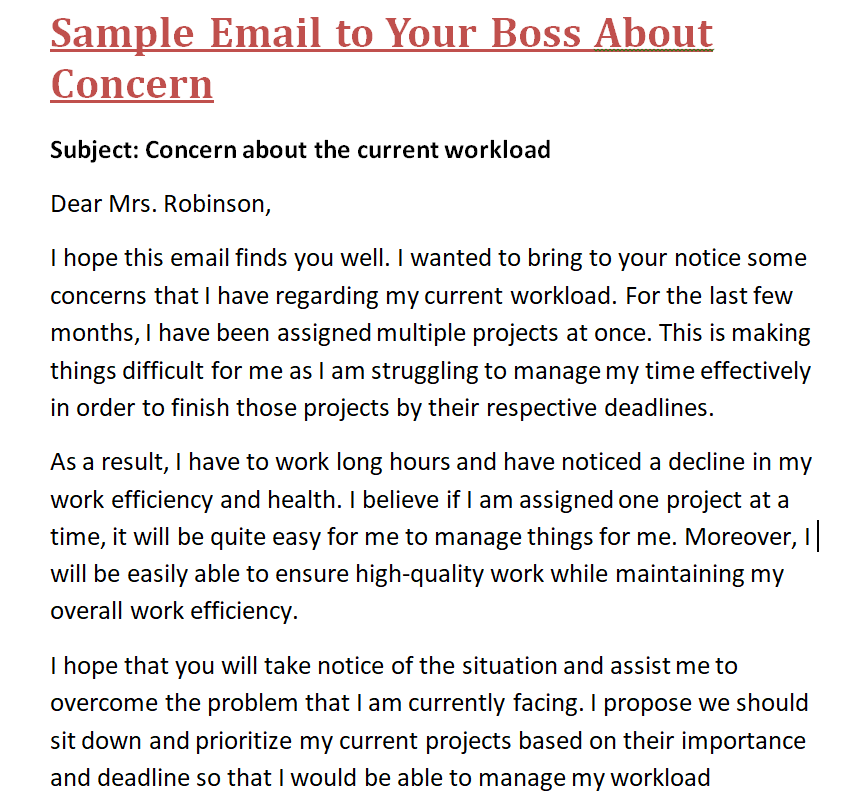
Subject: Concern about the current workload
Dear Mrs. Robinson,
I hope this email finds you well. I wanted to bring to your notice some concerns that I have regarding my current workload. For the last few months, I have been assigned multiple projects at once. This is making things difficult for me as I am struggling to manage my time effectively in order to finish those projects by their respective deadlines.
As a result, I have to work long hours and have noticed a decline in my work efficiency and health. I believe if I am assigned one project at a time, it will be quite easy for me to manage things for me. Moreover, I will be easily able to ensure high-quality work while maintaining my overall work efficiency.
I hope that you will take notice of the situation and assist me to overcome the problem that I am currently facing. I propose we should sit down and prioritize my current projects based on their importance and deadline so that I would be able to manage my workload efficiently.
Thanks a lot for your valuable time. I will be looking forward to your response on this matter.
Sincerely,
Paul Alexander
Assistant Finance Manager
111-222-7655
TEMPLATE
Email to Your Boss About Concerns Example
TEXT VERSION
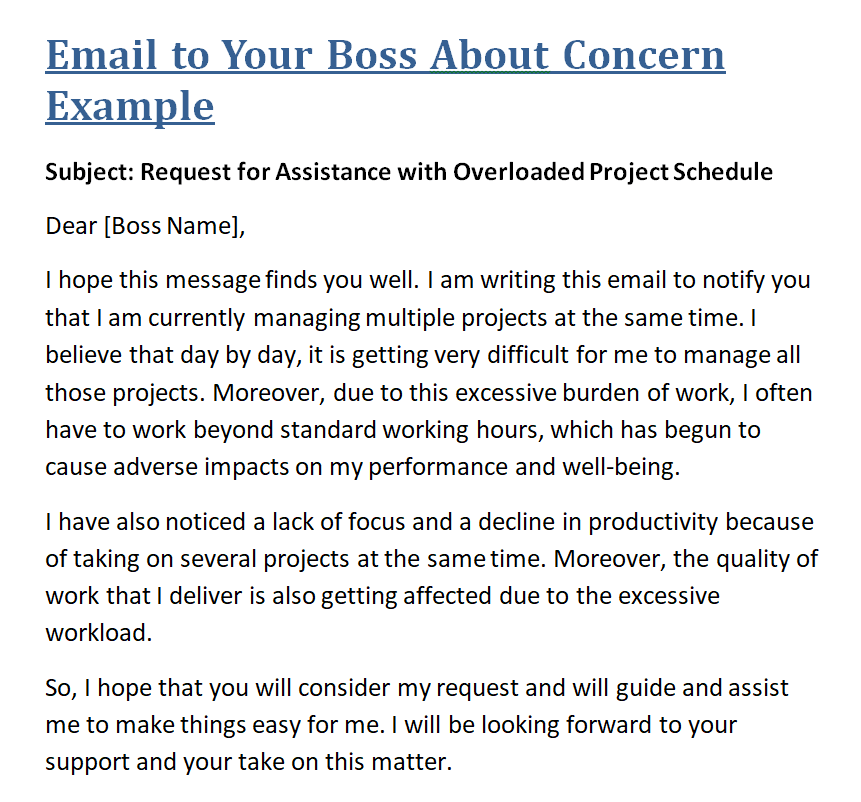
Subject: Request for Assistance with Overloaded Project Schedule
Dear [Boss Name],
I hope this message finds you well. I am writing this email to notify you that I am currently managing multiple projects at the same time. I believe that day by day, it is getting very difficult for me to manage all those projects. Moreover, due to this excessive burden of work, I often have to work beyond standard working hours, which has begun to cause adverse impacts on my performance and well-being.
I have also noticed a lack of focus and a decline in productivity because of taking on several projects at the same time. Moreover, the quality of work that I deliver is also getting affected due to the excessive workload.
So, I hope that you will consider my request and will guide and assist me to make things easy for me. I will be looking forward to your support and your take on this matter.
Thanks for your time and concern!
Sincerely,
[Name]
[Designation]
[Contact Number]
TEMPLATE
Tips to Write an Email to Your Boss About Concerns
If you want to know how to write a clear email to your boss about concerns, then here are some basic tips that you should consider while writing any such email:
- Write a concise subject line that is related to the purpose and message of the email.
- Make sure to clearly mention the problems, issues, or concerns. Be specific about mentioning those concerns as it will enable your boss to easily understand the situation and to take appropriate action.
- Keep your email direct and concise. Avoid including any unnecessary explanations or details.
- You can also propose a solution or action to overcome or resolve the issue or problem under consideration.
- Write the email in a professional way. The overall tone of your email should be respectful and courteous. Avoid using emotional language and maintain professionalism throughout your writing.
- Make sure not to miss any important detail or information.
- Timing is something that is quite crucial in such a situation. Try to write and send any such email when you know that the boss has enough time to review and respond to your concerns.
- Make sure to follow up on your email. If the boss requests some additional information or details, you must provide any such details or information as soon as possible. If the issue remains unresolved or is not resolved as per your expectations, schedule a meeting with the boss for further discussion.
- Always make sure to proofread your email before finally sending it to the boss.
Related templates for the next step
Record responsibilities and unresolved work before discussing a handover concern. handover report templates.
Keep factual confirmation of employment separate from an email raising a concern. employment certificate examples.
When clarifying a role, compare the question with the terms actually offered. offer letter formats.
Frequently asked questions
How do I begin an email about a workplace concern?
State the issue and the purpose of the message in the opening lines. For example, explain that you need clarification on priorities or would appreciate a private discussion about a recurring problem.
Should I include evidence?
Include relevant dates and concise examples. Share supporting records only when they help the recipient understand the issue and you are allowed to disclose them through that channel.
Can I ask for a meeting instead of explaining everything by email?
Yes. Briefly identify the topic and the decision or support you need. For sensitive matters, a suitable private discussion may be more appropriate than a long email thread.
What if the concern involves my manager?
Use the alternative reporting contact or procedure your organization provides. The appropriate route depends on the issue and workplace arrangements, so a generic email template cannot determine it for you.
How should I follow up without sounding hostile?
Refer to the original request, state the relevant deadline, and ask whether a discussion or decision is possible. Avoid assuming that a delayed reply means the concern has been dismissed.
