
Useful minutes make the next step clear after the conversation ends. These meeting minutes templates help record the decisions, responsibilities and context people need without trying to reproduce every sentence spoken in the room.
The meeting action minutes file puts decisions and an action log at the center. The discussion meeting minutes file leaves more room for a concise account of agenda items and their outcomes. Both are editable Word documents with space for meeting details, follow-up and review.
Choose the layout that reflects the meeting’s purpose and the organization’s recordkeeping practice. A short working team meeting may need an action-focused record, while another discussion may need more explanation of how an outcome was reached. The template supports the note-taker; it does not decide what a particular meeting is required to record.
A suggestion that needs one more question
During a planning meeting, someone says that the supplier should be contacted before the next discussion. The note-taker could record “contact supplier,” but that would leave several questions unanswered. Who will make contact, what information do they need and when must it be ready?
A brief clarification produces a more useful action: a named coordinator will request the updated delivery date by an agreed day and report the response to the project lead.
If the group has only discussed the idea and has not assigned it, the minutes should say that rather than presenting it as a commitment. The action-focused template makes the missing owner and date visible.
The discussion template can also preserve why the contact was needed, such as uncertainty affecting a milestone. Likewise, the result is a short record that helps someone do the work and lets the next meeting assess what happened.
Know what kind of record the meeting needs
Before the meeting begins, agree who will take the minutes, who will review them and what the record is expected to contain.
A project check-in may focus on decisions and actions, while a formal committee may have specific requirements for attendance, approvals and the treatment of agenda items. Use the appropriate organizational rules rather than assuming that a generic template covers every setting.
The two downloads provide a useful structure, but you can change headings and add required fields. Clarifying the purpose early helps the note-taker decide what deserves attention during a fast conversation.
It also reduces the chance of people expecting a detailed transcript when the agreed task was to prepare a concise decision and action record.
Prepare the structure before people start talking
Enter the meeting name, date, chair, note-taker and known agenda before the session. This leaves more attention for listening and less for formatting while the discussion is underway.
Check how attendance and apologies should be recorded, especially if people join or leave partway through an item. Keep supporting papers identifiable so readers can follow the references in the minutes later.
If a meeting has no clear agenda, ask for the purpose and expected decisions at the start. The minutes will be easier to write when the discussion has a visible structure.
Avoid filling the draft with assumptions about what will be decided; preparation should create space for the record, not prewrite an outcome before the participants have discussed it.
Distinguish discussion, decisions and actions
These three elements answer different questions. A discussion summary explains the relevant context, a decision states what was agreed, and an action identifies work someone will do afterward. Combining them in one vague sentence can leave readers unsure whether a suggestion became a commitment.
The discussion template separates the agenda item, summary and outcome, while the action template gives decisions and follow-up their own tables. Use wording that reflects the actual level of agreement.
If the group deferred a proposal, record that result and any next step instead of making the draft sound more settled than the meeting was.
Where a decision needs an exact form or reference, follow the organization’s established practice and confirm the wording through the proper review route.
2 downloadable templates and previews
These two downloads are editable files, with previews rendered from the actual documents. Choose the layout that fits your task, then use its download button to save the Word document or Excel workbook.
Keep a blank original and create a working copy before entering your own information. The preview shows the starting layout; longer text, additional rows and your local print settings may change how the edited file appears.
Check the finished document on screen and in print preview before sharing it. The two choices support different ways of organizing the topic, so you can use one independently or combine them where that is useful.
Meeting action minutes
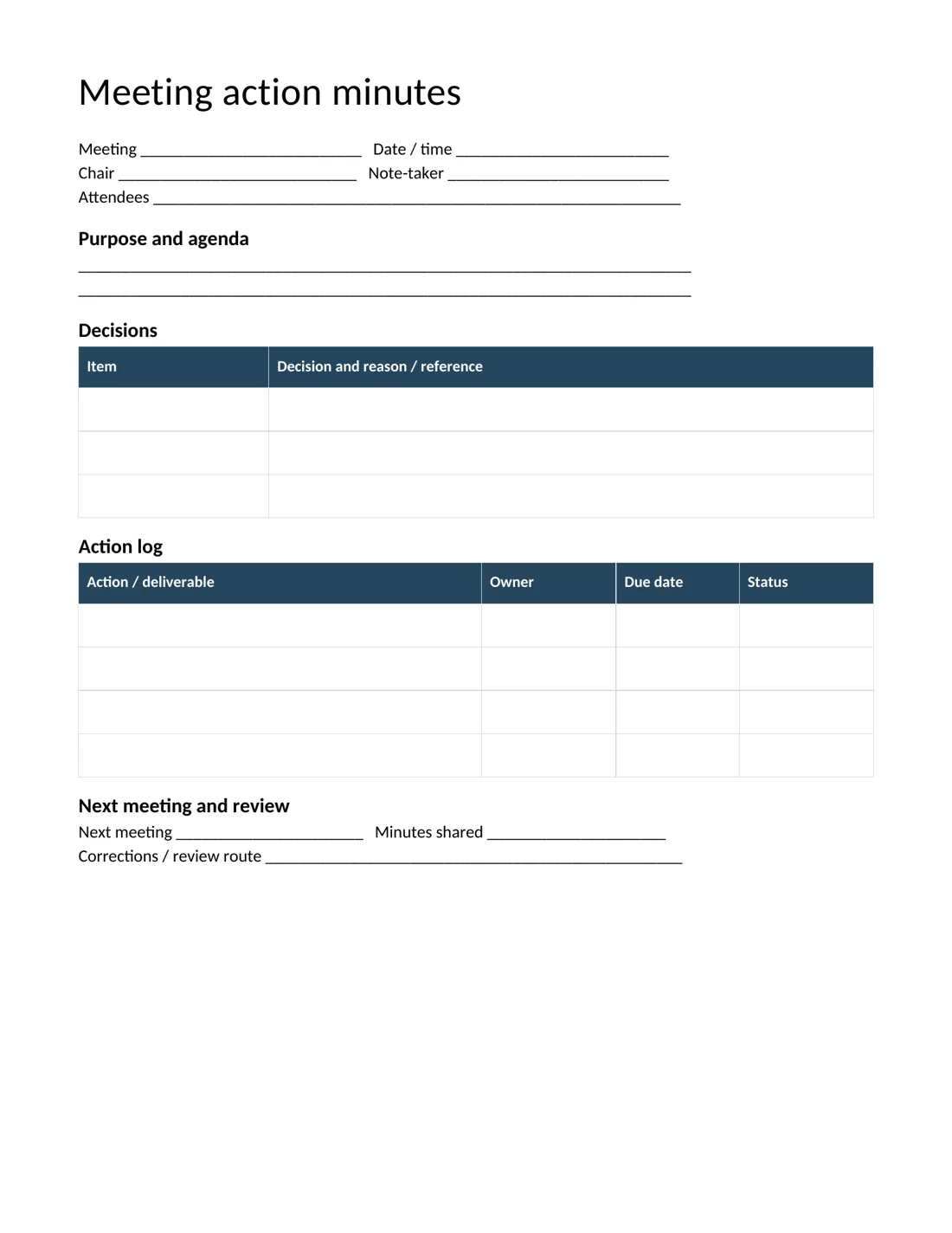
Download Meeting action minutes
Discussion meeting minutes
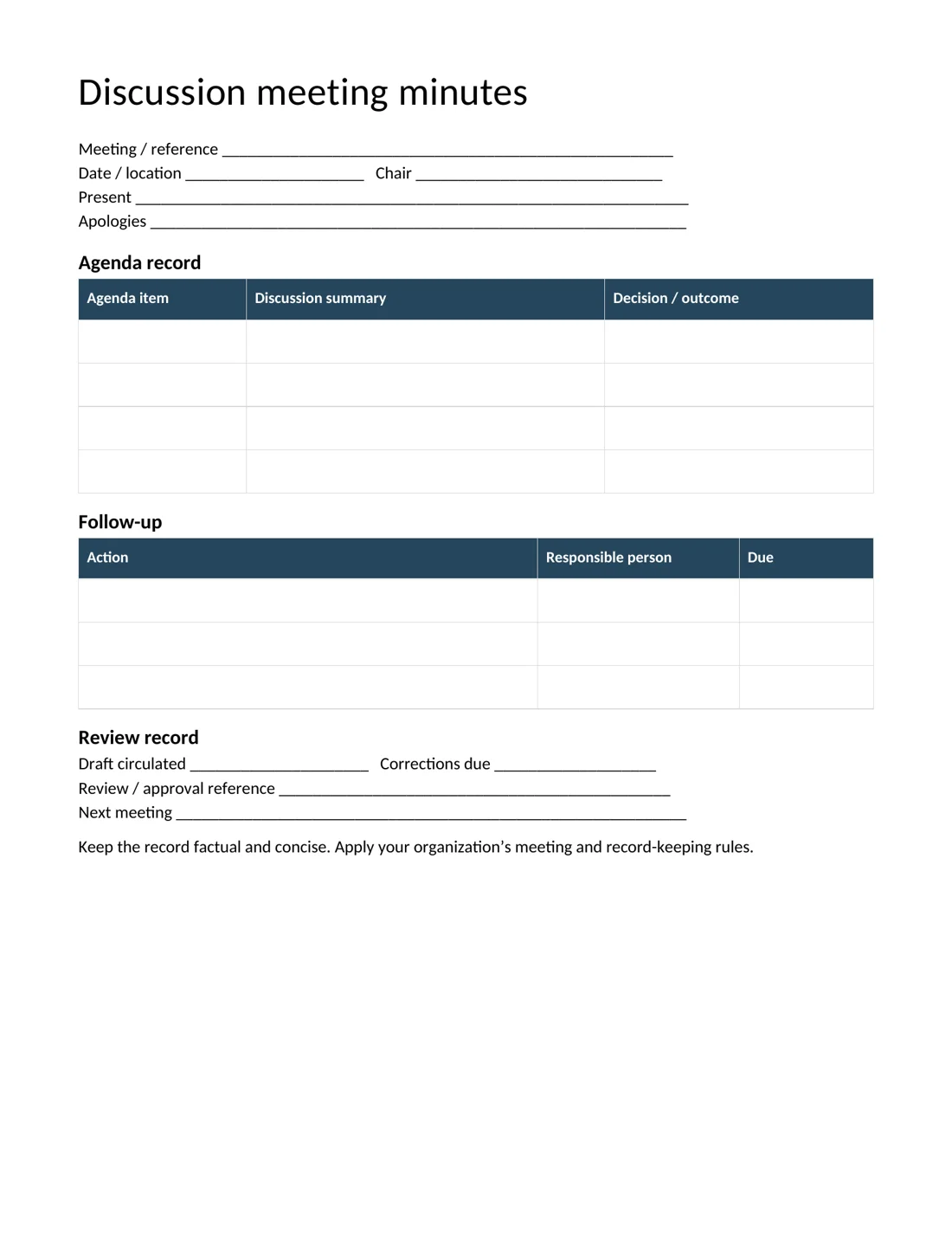
Download Discussion meeting minutes
Write actions that someone can complete
A useful action describes the deliverable or task, names the responsible person and gives an agreed due date. A line such as team to follow up is difficult to manage because neither the owner nor the completion point is clear.
If the group has not agreed a date, record that the date remains to be confirmed rather than inventing one after the meeting. Ask a short clarifying question while the action is discussed if the outcome is ambiguous.
The action log includes a status column, but the meeting minutes are usually a record of a particular session.
Decide whether ongoing status updates belong in that file or in a separate action tracker, and keep the distinction clear so the original record is not silently rewritten.
Summarize fairly and avoid unnecessary detail
Minutes should preserve the information needed to understand the outcome without becoming a running commentary on individual personalities. Use neutral language and avoid adding motives or interpretations that were not established in the meeting.
A summary can identify the main options or concerns where that context matters, but it does not need every repetition or aside. Attribute statements when the meeting’s practice requires it or when attribution is necessary to understand the record.
Handle sensitive material through the appropriate process and distribution route. The note-taker’s personal impressions should not slip into the official draft as fact. A reader who was absent should be able to follow the result without being led by loaded wording or unnecessary private information.
Review the draft while the discussion is still fresh
Prepare and circulate the draft according to the meeting’s agreed process. Check names, dates, decision wording, action owners and references before asking others to review it. Make clear whether the document is a draft, a reviewed copy or an approved record.
If someone proposes corrections, handle them through the proper route rather than allowing several competing versions to circulate. The templates include a review or corrections area to support that workflow.
A correction should improve the accuracy of what occurred, not quietly substitute a later preference for the original outcome. Preserve the final version in the usual location and tell recipients where it can be found.
Clear version handling helps most when you forward the minutes beyond the original participants.
Use the next meeting to close the loop
At the next session, review outstanding actions using the record or the separate tracker chosen by the group. Confirm completed work with enough evidence to understand the result, and discuss any revised date or responsibility openly.
Do not carry an unclear action forward indefinitely without checking whether it is still needed. If a new decision changes the earlier position, record the new decision with its date and reference rather than erasing the old one.
This preserves a useful history of how the work developed. Over time, recurring confusion about actions may indicate that the meeting itself needs sharper decisions or clearer ownership. Better minutes can reveal that problem, but the participants still need to resolve it in their discussions.
A final check before using the template
- Confirm the meeting’s required record and review process.
- Identify the meeting, attendance and agenda accurately.
- Separate discussion, decisions and follow-up actions.
- Name action owners and agreed dates.
- Use neutral wording and appropriate distribution.
- Mark the version and preserve the issued record.
Keep the editable draft and the issued record distinct
Save a blank master for future meetings, an editable draft for the current session and the final record according to the organization’s normal practice.
A PDF may be useful for distribution when a stable reading copy is wanted, but the review process still matters more than the file extension. Check page breaks and table rows after entering longer agenda summaries.
If the action log runs onto another page, make sure the headers remain understandable and no important text is clipped. Remove unused placeholders before circulation.
A final read from the perspective of an absent colleague is a useful test: can they identify the meeting, understand the decisions and find the people responsible for the next steps?
Related templates
For transferring responsibilities after decisions are made, use handover templates.
For a timed event running order rather than minutes, see event itinerary templates.
In addition, for a separate record of completed work, explore work completion certificate templates.
Frequently asked questions
Which meeting minutes template should I use?
Use the action-focused file when decisions and follow-up dominate. Choose the discussion file when agenda context needs more space. Adapt either to the meeting’s actual requirements and review process.
Should meeting minutes include everything said?
Usually a concise record is more useful than a transcript, but the expected level of detail depends on the meeting and its rules. Record the context, decisions and actions needed for an accurate account.
Can I update action status in the minutes later?
Decide how the group manages ongoing actions. A separate tracker can preserve the issued minutes while recording later progress. When you update the minutes, keep version changes clear and follow the agreed process.
Are the downloads editable in Word?
Yes. Both files are DOCX documents. Replace the meeting prompts, adjust the tables and inspect the final layout before circulating the reviewed or approved record.
You can also browse more options in the Samples category.
