
A good volunteer form should make it easy for a person to express interest and easy for a coordinator to respond. These volunteer application templates focus on the information needed for that first conversation: interests, useful experience, availability and a reliable contact route.
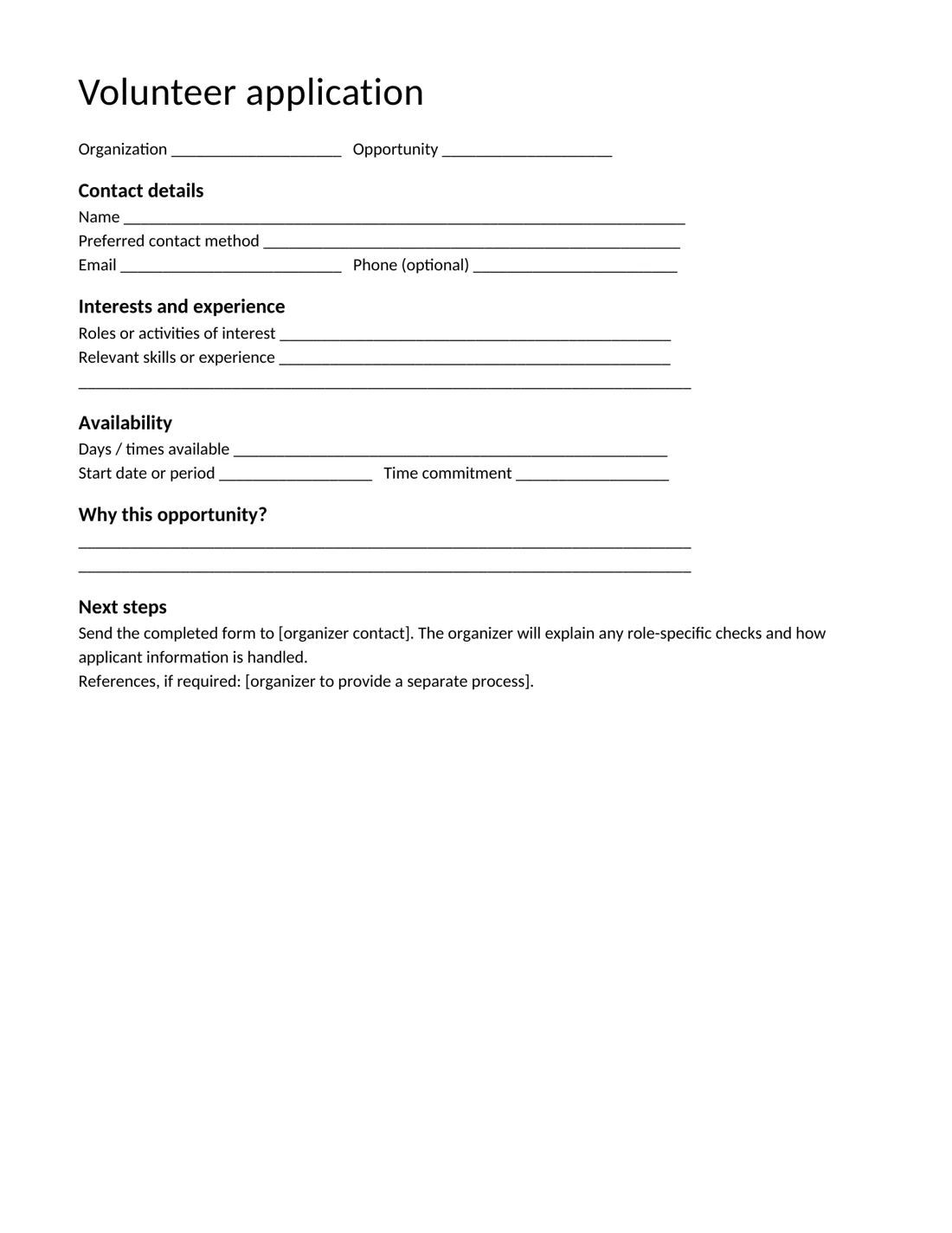
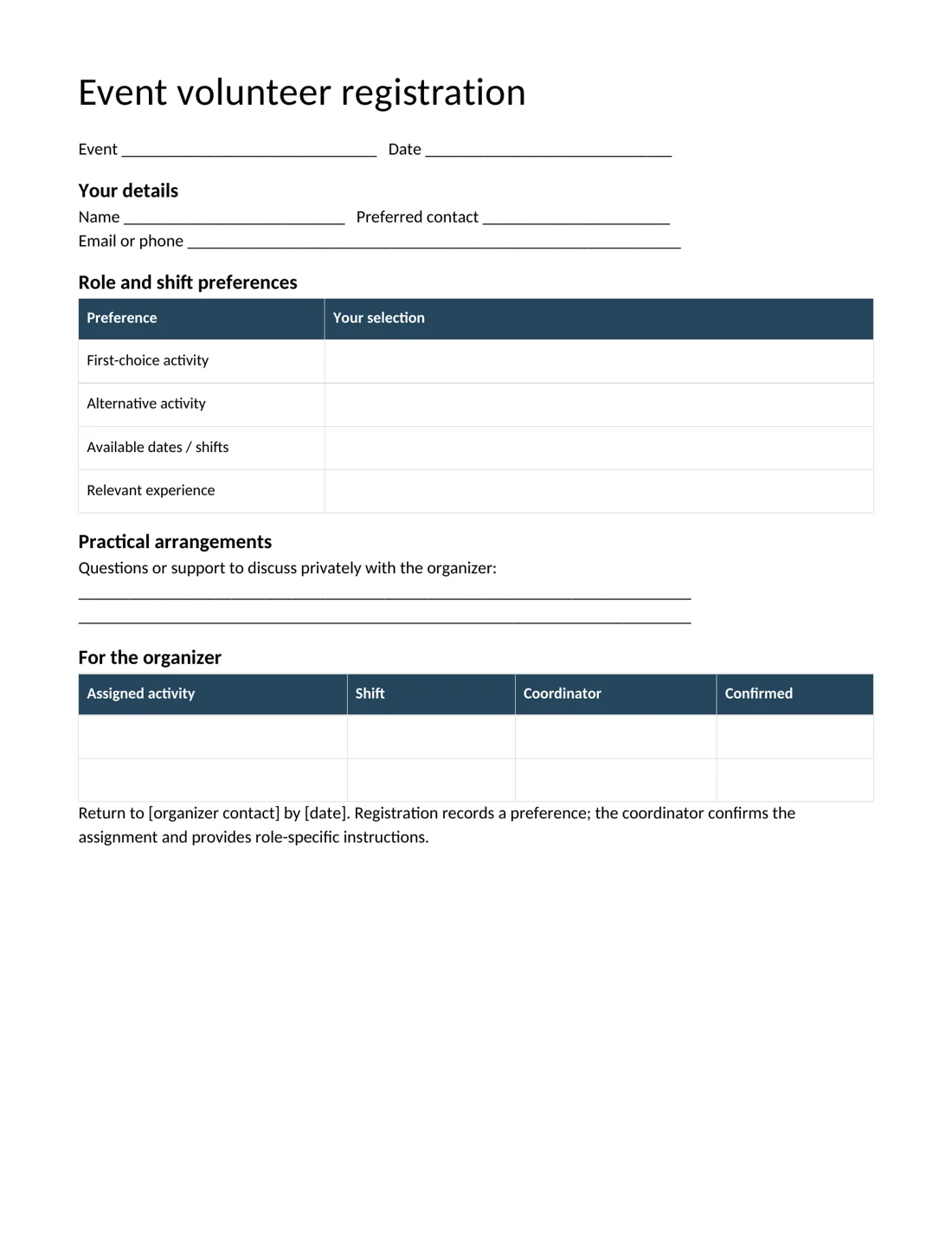
There are two editable Word downloads. The general volunteer application suits ongoing opportunities, while the event volunteer registration form helps organize activity and shift preferences for a particular event. The event version also separates the organizer’s assignment notes from the applicant’s responses.
Adapt the questions to the opportunity before sharing the file. A short form with a clear next step usually creates a better start than a long document collecting details nobody will use. Any role-specific checks, safeguarding steps or formal agreements should follow the organization’s appropriate process.
An event form that leads to a usable assignment
Suppose a neighborhood group needs help setting up a weekend community event. One applicant prefers welcoming visitors but is also willing to arrange chairs, and can attend only the morning shift. The event form records both preferences and that availability.
The coordinator checks the roster, assigns the welcome role and records a named contact in the organizer section. They then confirm the time and arrival arrangements with the volunteer.
Another applicant has useful setup experience but has not selected a shift, so the coordinator asks a follow-up question before making an assignment. In both cases, the form supports a conversation rather than deciding the outcome automatically.
The completed application does not replace a briefing about the venue or the work. It gives the organizer enough reliable information to plan that briefing and avoid treating an unconfirmed preference as a settled commitment.
Decide what the first form needs to achieve
Begin with the decision the coordinator will make after receiving the form. Perhaps they need to arrange a conversation, match a person to an activity or check whether a shift is possible. Ask for the information that supports that decision.
A general volunteer application can invite a short account of interests and experience without demanding a complete employment history. An event registration can focus on the date, preferred activity and available hours.
Explain whether submitting the form expresses interest or confirms a place; those are different expectations. The templates deliberately leave room for a coordinator to confirm the assignment later.
A clear purpose helps applicants answer with confidence and helps the organizer avoid collecting information simply because an older form happened to include it.
Make the opportunity understandable before asking for details
A form is easier to complete when the person knows what they are volunteering for. Add the organization or event name, a short description of the activity and a contact for questions.
If the role involves a particular setting, schedule or practical commitment, explain that in the accompanying information. Avoid making applicants guess whether previous experience is essential. If training will be provided, say so where accurate.
The volunteer application template contains a space for relevant skills rather than a rigid list of qualifications, which lets people describe useful experience gained in different ways. Keep the invitation welcoming and specific.
An understandable opportunity attracts more useful responses than a form that begins with several unexplained requirements.
Ask about availability in a way you can use
Availability is often more useful when recorded as a period or shift preference rather than a simple yes or no. For an ongoing role, ask which days or times are usually possible and when the person could begin.
For an event, identify the actual shift options in the information you share, then let the applicant state preferences and alternatives. Avoid interpreting a preferred shift as a confirmed assignment. The coordinator should check coverage, confirm arrangements and tell the person what happens next.
If plans change, update the working record rather than relying on the original form alone. A short confirmation message or agreed contact process can prevent someone arriving for a shift that was never formally assigned.
2 downloadable templates and previews
These two downloads are editable files, with previews rendered from the actual documents. Choose the layout that fits your task, then use its download button to save the Word document or Excel workbook.
Keep a blank original and create a working copy before entering your own information. The preview shows the starting layout; longer text, additional rows and your local print settings may change how the edited file appears.
Check the finished document on screen and in print preview before sharing it. The two choices support different ways of organizing the topic, so you can use one independently or combine them where that is useful.
General volunteer application
Download General volunteer application
Event volunteer registration
Download Event volunteer registration
Keep personal information proportionate to the stage
At the expression-of-interest stage, a name and a reliable contact route may be enough to begin. The general form makes a phone number optional, allowing the organization to decide which contact details it actually needs.
Do not add sensitive questions merely to make the application look thorough. If a particular role requires checks or additional information, explain the reason and use the appropriate separate process.
Likewise, questions about support needs should invite a private conversation rather than require unnecessary personal detail on a widely shared form. Decide who can see applications and where the working records belong before distributing them.
The template organizes responses, but the organization must supply its own information-handling explanation and follow its applicable practices.
Use skills questions to open a conversation
People may have useful experience without describing themselves in professional terms. A volunteer application can ask about activities they enjoy, tasks they have helped with or experience relevant to the opportunity. The coordinator can then explore the fit in a conversation.
Avoid making a polished written answer the only route to being considered when the role does not require that skill. If appropriate, offer another way to express interest through the named organizer. Keep the question on motivation short and clear.
You are looking for a sense of interest and expectations, not an essay designed to test enthusiasm. A person’s availability, support requirements and understanding of the activity may matter more than an elaborate account of why they want to help.
Separate applicant preferences from organizer decisions
The event volunteer registration template includes a distinct section for the coordinator to record the assigned activity, shift, contact and confirmation. This separation matters because an applicant may choose several options while the organizer ultimately confirms one.
Do not overwrite a person’s original availability in a way that makes the final assignment appear to have been their request. Record a change clearly and confirm it through the agreed contact route.
If more detailed allocation is needed, maintain a separate staffing schedule rather than expanding the application into a complicated roster. The form should remain easy to complete and read.
A simple link between the application and the confirmed assignment is more reliable than several undocumented copies circulating among helpers.
Finish with a clear and realistic next step
Before sending out the form, replace the organizer contact and any deadline placeholders. Tell the applicant where to return it and what sort of response to expect. If the organization cannot promise a response by a particular date, do not imply one.
Explain any later stage, such as an introductory conversation or role-specific briefing, in plain language. For an event, make sure the coordinator can answer questions about arrival, shift timing and the activity. For an ongoing role, make the route to further information easy to find.
Review the blank master after the first few applications. If people repeatedly leave the same question unanswered, the wording or the information supplied beforehand may need improvement rather than another reminder to complete every field.
A final check before using the template
- Name the organization, event or opportunity clearly.
- Ask only for information needed at this stage.
- Replace contact and deadline placeholders.
- Explain how preferences become confirmed assignments.
- Use the appropriate separate process for role-specific checks.
- Check space, readability and the return instructions.
Review the form from the applicant’s side
Open the document as if you had never met the organization. Can you tell what the opportunity involves, which questions are essential and how to ask for help? Is there enough space to answer without squeezing text into a narrow field?
Try a short sample response in a working copy and check the page after editing. If the form will be printed, leave adequate writing room. If it will be returned digitally, avoid instructions that depend on handwriting or a particular device.
Keep the original blank file separate from applications, and remove sample answers before sharing it. A clear, modest form signals that the coordinator has thought about the volunteer’s time as well as the organization’s needs.
Related templates
For a simpler attendance or interest list, see sign-up sheet templates.
For the day’s running order, use event itinerary templates.
If the activity includes collecting fundraising orders, explore fundraising order form templates.
Frequently asked questions
What is included in these volunteer application downloads?
The collection includes a general application for ongoing opportunities and an event registration form for activity and shift preferences. Both are editable Word documents with clear contact and next-step fields.
Does submitting the event form confirm a volunteer shift?
The template treats the submission as a preference. The organizer should confirm the activity, shift and contact arrangements separately and record that confirmation in the coordinator section.
Should I add background-check questions?
Use the process appropriate to the particular role and organization. Explain any required checks and handle the information through that process rather than adding broad sensitive questions to every expression-of-interest form.
Can the forms be printed or completed digitally?
Yes. Edit the DOCX file for your opportunity, check the available response space and then share a digital copy or print it. Keep completed applications separate from the reusable blank master.
You can also browse more options in the Samples category.
