
Certificate of Authenticity Templates. A certificate of authenticity connects a named artwork, collectible, or product with a statement from its issuer. Its usefulness depends on the evidence and identity behind that statement, not the decorative border. Choose a template with enough space to identify the item precisely and explain what the issuer can actually confirm.
For original artwork, record the title, creator, medium, dimensions, and creation date if known. For a numbered edition, distinguish the individual piece number from the total edition size. A certificate should travel with the correct item and have a record retained by the issuer.
Browse the previews and resource links, or use the guide below to choose the right layout.
Build the document around its purpose
Item identification. Use a title, description, photograph reference, serial number, or other distinguishing information that connects the certificate to one specific item.
Creator and provenance. Identify the creator and accurately describe the issuer's knowledge of the work. Do not invent ownership history where records are incomplete.
Edition details. Record the piece number and edition size where relevant. Keep edition records consistent across certificates.
Issuer statement. Explain what is being certified and who is making that statement. Include the issue date and an appropriate signature or verification reference.
Prepare and review your version
- Identify the item and gather the records supporting the proposed statement.
- Choose a layout that separates item details from the issuer's declaration.
- Check names, measurements, edition numbers, and photograph references.
- Issue the certificate with the matching item and retain a traceable record.
Putting the layout to work
An artist's certificate for a print might identify the title, artist, printing medium, paper size, and edition number 12 of 50. The artist can state that the described print belongs to that edition. Avoid adding claims about investment value or future resale prices.
Adapt the layout to the situation
An original painting needs different details from a limited-edition print or a manufactured collectible. Match the description and issuer statement to the item rather than copying every field from a decorative sample.
From a sample to an issued document
Keep the blank master separate from the completed version. Replace every bracketed placeholder and read the result as a whole; a correct name at the top does not prevent an old name remaining in a later paragraph. Check attachments and referenced dates together. If approval or a signature is required, complete that process before describing the document as issued or agreed.
An editable document is useful for revising wording, while a fixed PDF can preserve the reviewed layout for sharing. Neither file extension establishes authority, acceptance, or authenticity. The person issuing or agreeing to the document must check the facts and use the process appropriate to its purpose.
Before sharing the finished version
A template cannot authenticate an unknown item. Avoid unsupported guarantees, copied signatures, and vague descriptions such as genuine artwork without identifying the work. Ownership and copyright are separate matters and should not be implied by an unclear certificate.
Related documents for the next step
Membership certificates confirm membership rather than an item's authenticity. See membership certificate templates.
An ID card can identify an authorized member or staff representative. See id card templates.
Use an invoice separately to record the sale and amount charged. See invoice formats.
Previews and linked resources
The collection includes file links and external source pages. File type is shown on direct-file buttons; external pages may offer paid options or additional steps. Some reference images have no editable file attached.


Download two customizable templates
These original downloads are hosted on Templates Front. Each ZIP contains the template files and instructions described below.
Artwork provenance certificate
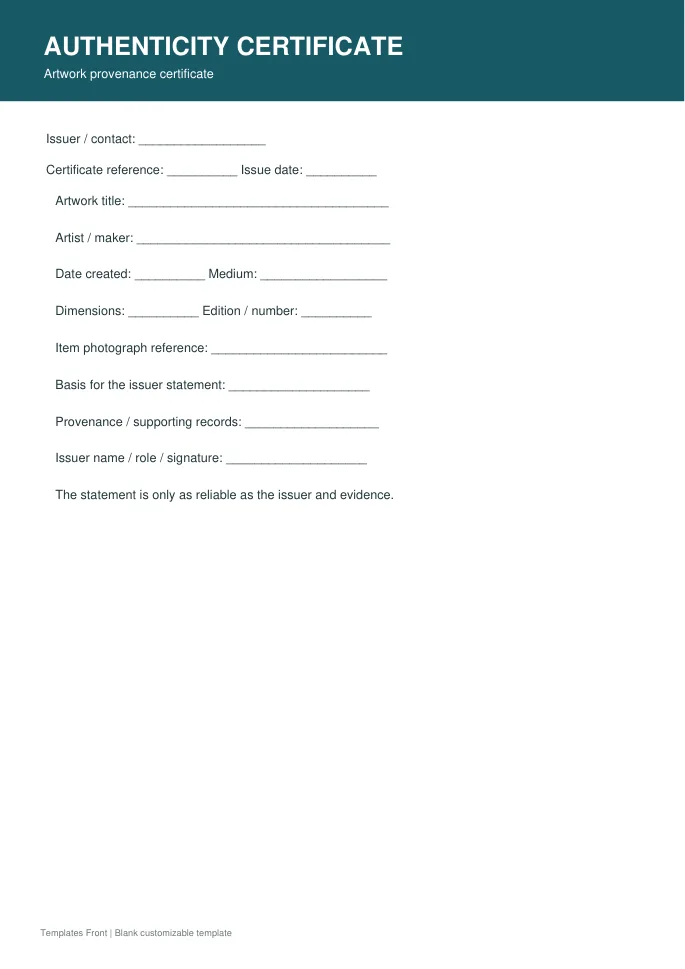
Printable PDF and editable HTML document. Open the HTML in a browser, click the text to edit, then print or save. Tables do not calculate automatically.
Collectible item authenticity record
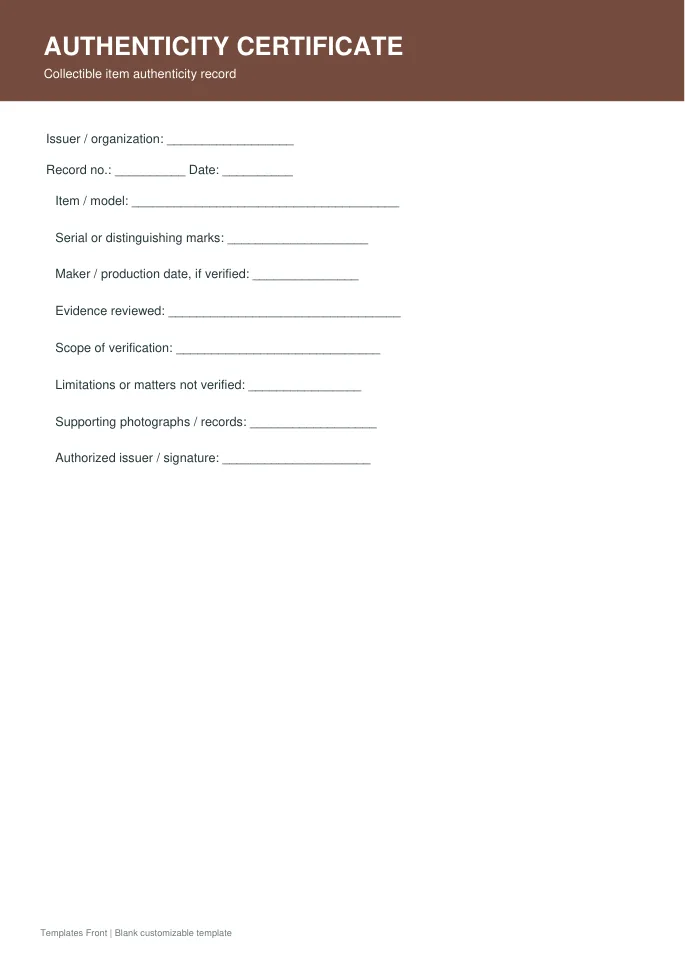
Printable PDF and editable HTML document. Open the HTML in a browser, click the text to edit, then print or save. Tables do not calculate automatically.
Frequently asked questions
Does a certificate prove authenticity by itself?
Its value depends on the issuer, the evidence, and its connection to the item. A downloaded layout alone proves nothing.
Should I include a photograph?
A suitable image or image reference can help connect the certificate to the item, alongside identifying details.
Can I add an edition number?
Yes, where the work belongs to a documented edition. Use the actual piece number and edition size.
How do I tell a downloadable file from a source page?
The buttons distinguish file links from external source pages. A source page may contain a download, a paid listing, or further information. Check its file type, availability, and usage terms before relying on it. A preview by itself does not promise an editable file.
